Water Delivery Management Software for 20L Jar Businesses
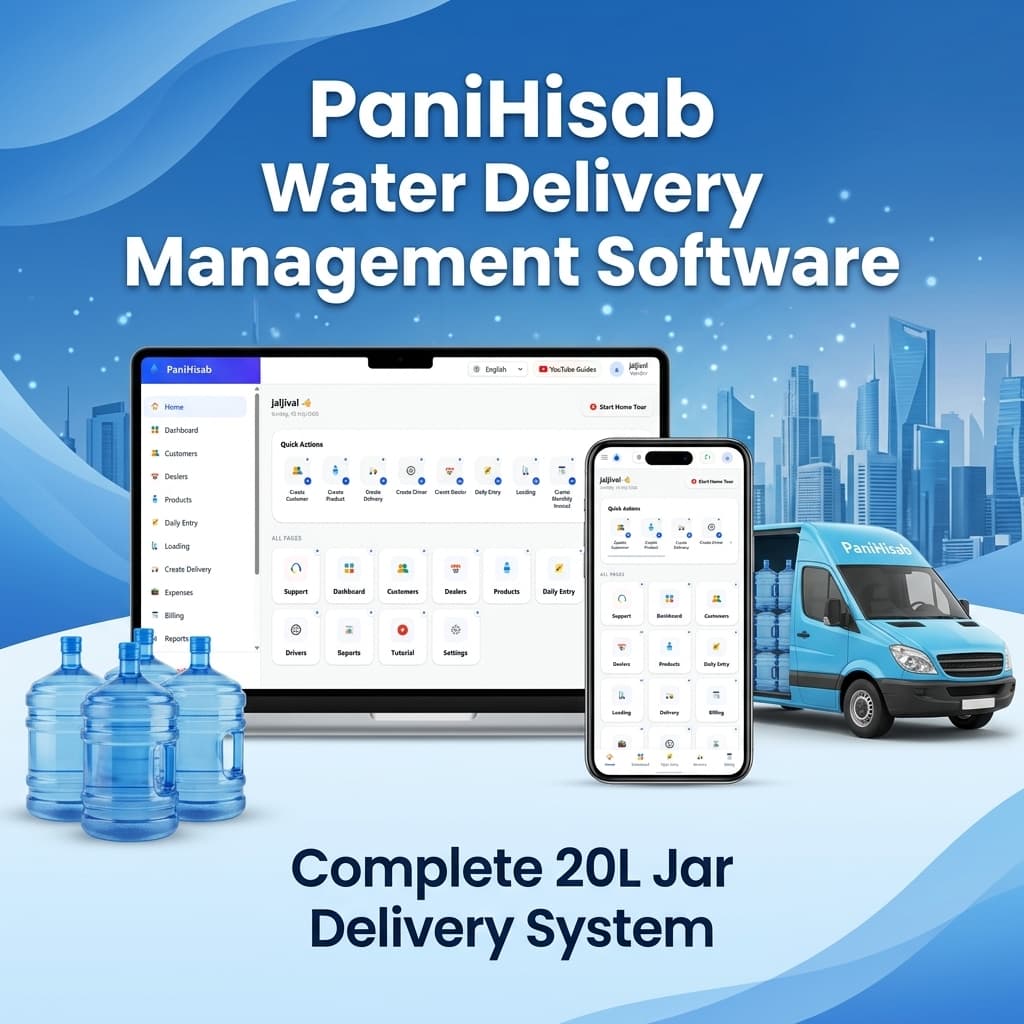
PaniHisab is software for water delivery management — also searched as water delivery management software, water jar delivery software, or water delivery service software. It helps Indian water suppliers manage daily delivery entries, customer billing, payment follow-up, jar return tracking, and WhatsApp invoices without relying on a paper diary.
Daily delivery entry
Record customer-wise jar deliveries during the route instead of updating the register later from memory.
Monthly billing
Generate bills with pending balances, customer rates, and monthly totals without manual calculation.
Jar return tracking
See which customers still hold empty jars so you can reduce stock leakage and billing disputes.
Water Delivery Management Software — Feature Checklist
Whether you call it water delivery management software, water jar delivery software, or software for water delivery management — here's what it should actually include:
| Capability | PaniHisab |
|---|---|
| Customer-wise daily delivery entry | ✅ |
| 20L jar deposit + return tracking | ✅ |
| Automated monthly billing with carry-forward dues | ✅ |
| WhatsApp bill sharing (one tap) | ✅ |
| Payment collection & dues dashboard | ✅ |
| Delivery zone / route management | ✅ |
| Hindi, Gujarati + 8 more Indian languages | ✅ |
| Works for delivery-only or own-plant businesses | ✅ |
Why water delivery software matters
A water delivery business looks simple from outside, but the daily workflow becomes messy very quickly. One customer takes 2 jars today, another takes 1 jar tomorrow, a third customer pays late, and someone else still has 4 empty jars pending. If all of that is tracked in a notebook, the month-end billing process becomes slower and more error-prone every time the customer count grows.
Water delivery software solves that by turning daily operational data into billing-ready records. Instead of counting pages in a diary at month-end, you already have each customer's delivery history, payment status, and pending balance in one place.
How Water Delivery Management Software Works
Most water delivery management software follows the same five-step daily and monthly cycle. Here is how it works in PaniHisab:
Who Uses Water Delivery Software?
Water delivery software is used across several types of Indian water businesses:
Water Delivery Software Pricing in India
PaniHisab uses simple flat pricing — no per-customer or per-delivery charges. Enterprise water delivery ERPs usually cost 10–12× more and are built for much larger operations.
| Plan | Price | Best for | Includes |
|---|---|---|---|
| Basic | ₹99/month | Up to ~200 customers | Delivery entry, billing, WhatsApp bills, jar tracking, all languages |
| Pro | ₹199/month | Up to ~400 customers | Everything in Basic + multiple zones, multiple delivery staff, advance tracking |
Both plans include a 15-day free trial with no credit card. See full details on the pricing page.
What PaniHisab does as water delivery software
PaniHisab is designed specifically for Indian 20L jar suppliers, RO water plants, and small local water delivery businesses. It focuses on the actual work that happens every day: entering delivered jars, maintaining customer-wise pricing, generating monthly bills, sharing bills on WhatsApp, and keeping track of who still owes money.
Because the software is built around water delivery workflow, it is more useful than a generic accounting app for suppliers who need to connect route-side activity with customer billing. That is the main reason category pages like this one matter: people searching for water delivery software usually want something more operational than a standard invoicing tool.
Best fit for small and growing suppliers
PaniHisab is especially relevant for businesses with roughly 10 to 300 customers. At that stage, the business is too large for manual record-keeping but often does not want expensive enterprise delivery software. Owners need something that is affordable, fast to start, and easy enough for everyday use by family members or delivery staff.
This also makes PaniHisab a strong option for suppliers searching terms like water delivery software India, 20L jar delivery software, water supplier software, and small business water delivery software.
Why language and simplicity matter in India
Many Indian water businesses are owner-led and run by small teams. The person doing daily entry is not always comfortable with complex English-heavy software. If the interface feels slow or confusing, adoption drops and the software stops being useful.
PaniHisab has strong Hindi and Gujarati positioning because those languages matter in actual field use. That makes it easier for teams to record deliveries consistently, which is what ultimately improves billing accuracy.
Related high-intent pages
If billing is your main problem, read the water billing software page. If your focus is on supplier workflow, go to water supplier billing software. If jar accounting is the main issue, check water jar management software. If you want a step-by-step framework for choosing and migrating to WDMS, read our complete water delivery management software guide. To compare PaniHisab with other tools, see the water delivery software comparison.
Common Questions
What is water delivery software?
Water delivery software helps suppliers manage daily delivery entries, customer billing, monthly dues, payment records, and jar return tracking from one system instead of using notebooks or spreadsheets.
Who should use water delivery software in India?
Any 20L jar supplier, RO water plant, or local water delivery business serving homes, offices, and apartments can benefit from water delivery software, especially once the business grows beyond a small notebook-based workflow.
Why is PaniHisab different from generic billing apps?
PaniHisab is built around the operational needs of water suppliers: customer-wise delivery entry, jar tracking, recurring monthly billing, WhatsApp bill sharing, and Hindi or Gujarati usability. Generic billing apps usually do not match that workflow well.
Is water jar delivery software the same as water delivery management software?
Yes — water jar delivery software, water delivery management software, and water delivery software all refer to the same category of tool: software that tracks 20L jar deliveries, customer billing, jar returns, and payments for water suppliers. PaniHisab is built specifically for this category.
How much does water delivery management software cost in India?
PaniHisab water delivery management software starts at ₹99/month for up to about 200 customers, with a ₹199/month plan for larger routes. It includes a 15-day free trial with no credit card. Enterprise water delivery ERPs like Trakop or Rekart typically cost ₹1,250/month or more, which is overkill for most small 20L jar businesses.
Is there online water delivery software for small businesses in India?
Yes. PaniHisab is online (cloud-based) water delivery software that runs in a web browser and on Android/iOS — nothing to install. Your customer list, delivery history, and pending balances stay backed up online, so you can manage deliveries and billing from any phone. It is designed for small and growing water delivery businesses with 10 to 300 customers.
What features should water delivery service software have?
Good water delivery service software should include customer-wise daily delivery entry, 20L jar deposit and return tracking, automated monthly billing with carry-forward dues, WhatsApp bill sharing, a payment/dues dashboard, delivery zone or route management, and local-language (Hindi/Gujarati) usability for delivery staff. PaniHisab covers all of these in one app.
Updates, business tips aur real vendor updates ke liye hume Instagram pe follow karein:@officialpanihisab.in